


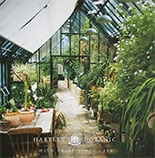

Some time ago there was a TV interview with Roberto Burle Marx, the Brazilian landscape architect, historian, artist, and conservationist. It was framed by a tour of Sítio, his house and extensive garden in hills above Rio de Janeiro. Burle Marx was a plant collector focused on conserving the under-appreciated and thus threatened flora of Brazil and the Amazon. Sítio was his laboratory, and the greenhouses there were home to his vast native plant collection and also the setting for the school opened to foster the next generation of environmentally aware landscape architects. I most clearly remember the enormous array of tropical plants that filled his greenhouse, and the astonishing fact that Burle Marx had collected most of them from threatened populations in the Amazon basin to integrate them into his landscape designs. This was native gardening on a much different scale, and a testament to what integrating such plants into popular garden culture can mean to the environment.

From the 1930s Burle Marx (1909-1994) was an artistic leader in the burgeoning modernist movement but by the 1960s had read the writing on the wall; while he designed landscapes and gardens, domestic and public, that were firmly grounded in the mid-century modern aesthetic, he realized the value of incorporating native plants in preference to imported, nonnative material. The results were vivid expressions of post-war joie de vivre, achieved by abandoning the formal symmetry that had long dominated Brazilian landscaping and architecture in favor of sensuous undulating swathes of lush tropical foliage contrasting in shape, size and color with deliciously diverse beds of flowering plants as counterpoints.

The English architect, Sir Peter Shepheard, author of Modern Gardens (1953), wrote that Burle Marx’s most valuable lesson for Brazil “has been the one William Morris and Gertrude Jekyll preached in England—the paramount value of plants native the country. For Burle Marx, many of the plants he introduced via his landscapes were native to the Amazonian jungle, and until he came along, had been weeds, but as Shepheard noted, the “luxury and splendour of tropical vegetation” contrast ‘splendidly’ with architectural form.

Having grown some thrilling tropicalismo plants in my Austin, Texas garden, I couldn’t agree more — and that was without a greenhouse! The popularity of his design platform has spread globally; in the USA the only garden in the northern hemisphere in which Burle Marx had a hand is the Cascade Garden at Pennsylvania’s Longwood Garden, which has recently been reworked to better reflect the maestro’s aesthetic.
In Brazil, Burle Marx had to some extent did not reach the levels of popularity he had in other parts of the world, but that is changing. The Instituto Burle Marx is scheduled to open in 2028, housed in the Casa Cavaneles in Petrópolis, Rio de Janiero, a house designed by modernist icon, Oscar Niemeyer set in gardens by Burle Marx. The Instituto will house the extensive collections of Burle Marx’s painting, sketches, notebooks, photographs and other related ephemera, and will work alongside the UN Sustainable Development Goal 11 (“Sustainable Cities and Communities”) and preservation of native biomes.

For Burle Marx, the work continues, and the word spreads with an exhibition dedicated to his standing as one of the world’s great environmentalists and artists in an exhibition at the Zentrum Paul Klee in Bern, Switzerland, 17 October 2026 to 7 February 2027, in collaboration with the Instituto Burle Marx and the Sítio Burle Marx.
©Ethne Clarke 2026
For information about the restoration of the Cascade garden:
https://longwoodgardens.org/blog/2024-09-26/stone-stone-and-plant-plant-reimagining-cascade-garden
Among a crowd of online infomercials about Burle Marx, these three YouTube videos standout as worthwhile viewing, taking you on a tour of Sítio. In Portuguese with English subtitles:
#2 https://www.youtube.com/watch?v=aR6PMQZNt9A
#3 https://www.youtube.com/watch?v=1Lu-9-EB3Vw
#4 https://www.youtube.com/watch?v=xGpOBXu4KKQ
About the Burle Marx institute: https://institutoburlemarx.org/en
About the exhibitionat Zentrum Paul Klee: https://www.zpk.org/en/ausstellung/roberto-burle-marx