




I have been writing about gardens and plants for over 30 years and, when I started, most garden writing was purely practical. Writers explained how to grow it, where to plant it and, typically, you’d get dig a hole one foot deep in a sunny place and then do this and that. It made me want to scream, because gardening is so much more than the purely practical. It’s positively magical and I remember my first published article, on winter in the garden beginning ‘the sun barely rises above the rooftops even at midday.’ There wasn’t a mention of digging a hole.
It’s the inspirational side of gardening drives me on and, although I still have to dig the holes, I’d rather write about the beauty of plants rather than the planting depth. I suppose I must be a hedonist through and through and there’s one group of plants that has lifted my spirits during one of the greyest winters I have ever endured. It’s the winter-flowering Daphne bholua. I have spent many an afternoon inhaling their lily-like scent at close quarters and it’s been bliss. And on occasional warm afternoons (and they’ve been very occasional here) the lower end of the garden has been awash with winter fragrance because that’s how winter-flowering plants lure in the pollinators. Scent!
Daphne bholua is a Himalayan species also called paper daphne because the Nepalese and Tibetans use the bark to make paper. An excellent monograph by Brian Mathew and Chris Brickell, first published in 1976, explains that it’s found ‘over a considerable altitude’ and is most prominent in the Eastern Himalayas. It has been grown here since the late 1930s, but most plants were killed off during the winter of 1962-1963. A winter I remember well, because we got six weeks off school because the boiler kept breaking down. Skating and sledging was much more fun.
There are deciduous forms of D. bholua that lose their foliage in winter, and evergreen forms that keep their foliage in most gardens. Cold Aston winters usually defoliate mine and the winter of 2010 cut them back badly, but they did recover to a large extent. The deciduous forms of D. bholua are found above 3000m and the most well-known is ‘Gurkha’ which was wild collected as a seedling by a Major Spring-Smyth in 1976 who served with the Gurkhas. There is a Gurkha Memorial Garden, laid out by him in 1997, at the Sir Harold Hiller Arboretum near Romsey in Hampshire.
Normally deciduous plants are hardier and easier than evergreens, but I have found D. bholua to be an exception. The deciduous ‘Gurkha’ is impossible to keep here because it has an alpine tendency and therefore needs excellent drainage. Its name includes glacialis, which says it all. My garden is exposed and rainy, because we are on the high Cotswolds and I’ve seen off many an alpine – including ‘Gurkha’. It’s the evergreen daphnes that I do well with so it was another planting opportunity.
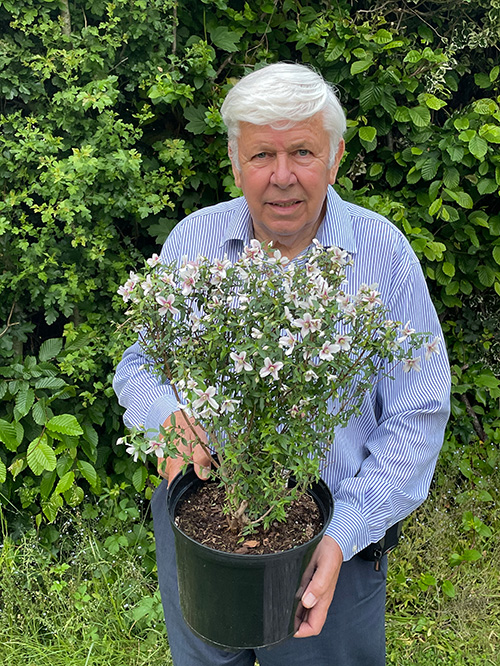
The most available is ‘Jacqueline Postill’. This was raised at Hilliers by Alan Postill and named after his wife. He found it in a batch of seedlings raised from the berries of ‘Ghurkha’. Alan selected it because it had an evergreen tendency and it was launched in that late 1990s. I acquired my first one then and I still have it. That plant was grafted, but the later plants I acquired were grown on their own roots from cuttings and, as a result, they produce suckers. That is a definite advantage. Should the main plant succumb in a hard winter, its suckering habit will like as not save it. ‘Jacqueline Postill’ is a columnar plant that can reach 4 metres and I held my breath a couple of years ago, when I cut one of mine back to five feet in height, but all was well. It didn’t die!
I have gone on to buy many more named forms of D. bholua, because their highly-perfumed waxy flowers defy hard weather. They’re planted in semi-shady positions mainly, but last year’s hot summer affected one of my Postills, although I’m hoping it will come back. It got too much sun and heat. Semi-shade is best.
I adore ‘Sir Peter Smithers’, an evergreen daphne raised by him in the 1970s in his Swiss garden Vico Morcote. It has darker buds that open to pink. The clusters of buds contain more flowers than ‘Jacqueline Postill’ and it flowers slightly later. Sir Peter Smithers (1913 – 2006) was said to have inspired Ian Fleming’s James Bond, having been a World War II spy and a diplomat. I don’t remember the fictional James being into botany though. More bottoms than botany.
My all-time favourite is D. bholua ‘Mary Rose’, which was discovered in Cornwall by Paul Adcock and that’s as much as I know. This flowers later for me and it bears tight clusters of deep-pink flowers held in purple-pink buds, flowering right into mid-March. So far, this has kept its foliage and the scent is more intense – although that might be its brighter position in the garden. Nectar flows better in warmer brighter situations. Fragrant plants silk in shade.
I’ve recently acquired ‘Cobhay Coral’ and ‘Cobhay Purple Clouds’ from Karan Junker’s Devon nursery. ‘Purple Clouds’ flowered this year and the lavender-pink flowers are very attractive. One of my gardening friends has a six-foot high ‘Cobhay Purple Clouds’, so I live in hope.
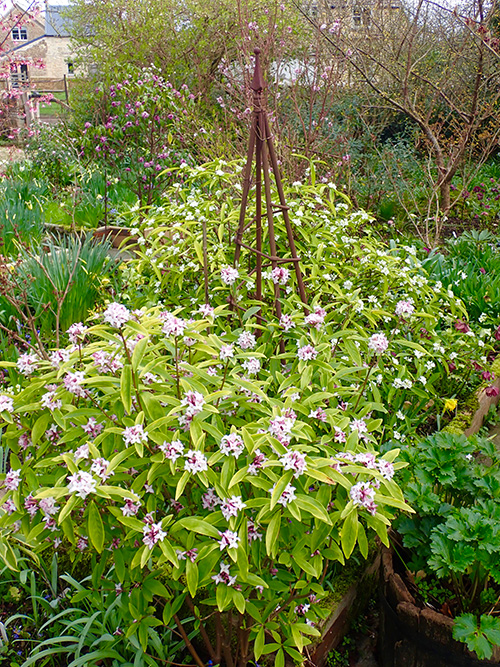
You’ll also find ‘Spring Beauty’, a hybrid between D. sureil x D. bholua. This was raised by Hampshire-based daphne expert Robin White in 2001. Dark crimson flower buds open to cool-pink. The cluster of flowers is looser, but highly scented and this has proved a good doer for me and it flowers at the same time as my named forms of Daphne bholua. Other Spring Cottage daphnes include ‘White Queen’, also raised by Robin White. This is thought to be a hybrid between D. acutiloba x D. sureil. This is highly fragrant, more so than the others, and it makes a wide plant at the head of some well-used steps. ‘Garden House Ghost’ is another white, but neater in habit.
- wolongensis ‘Guardsman’ is also doing well for me. It is four weeks later than D. bholua here and it has smaller clusters of pink flowers on a neat upright evergreen – hence the name ‘Guardsman’. This rare species originates from the Wolong valley in Sichuan China, although ‘Guardsman’ was selected by Robin White. Robin has bred many summer-flowering dahpnes and his 2006 monograph is escellent.
Climate change has altered the flowering times and Daphne odora, which used to flower in April, is often out by late winter. I have a variegated form named ‘Marianne’ which came from Hortus Loci near Basingstoke. The green foliage has a bright yellow margin and the flowers are a cool pink. The most common form of D. odora is ‘Aureomarginata’ and this has evergreen leaves slightly edged with the merest hint of cream. This is the daphne to start with, because it’s the easiest of all. It needs space, up to five feet of it, but it’s highly fragrant and long-lived.
Daphnes are expensive, but you can take cuttings and these will root in a warm place in your Hartley greenhouse in coarse horticultural sand. Great care must be taken when potting them up though, because daphnes hate root disturbance. They die if you transplant them. Cuttings will take several years to achieve a suitable size to plant out. I have discovered something very interesting. Hayloft Plants are selling ‘Mary Rose’ and they were grown in small 9cm pots. I potted five of them into larger pots and placed them in a cold frame and they went backwards over several weeks. I put them into the ground and they bedded themselves in quickly. I am hoping that they will flower next year.