





February Fill Dyke has certainly lived up to its name this year! It’s traditionally one of the wetter months, averaging between 50mm and 100mm of rainfall, up to three inches in old money. This year I know that we’ve had far more, because the accurate Met Office rain gauge my husband so thoughtfully gave me one Christmas, NOT, has recorded three inches at least three times. Parts of the west country have had forty consecutive days of rain and it’s been wet since December 20th here.
Despite all that, the weather Gods have smiled upon me this month. The important VAL days have been dry. The sun shone when I went to visit Suffolk on the 8th, when I had a garden tea here on the 11th and when I went to Michael Heseltine’s Thenford garden on the 14th. Yes, I have been snowdropping and socialising, such a change from my usual solitary pursuits, writing and gardening. Then I only get to wave at Guy, our postman, when we have post.
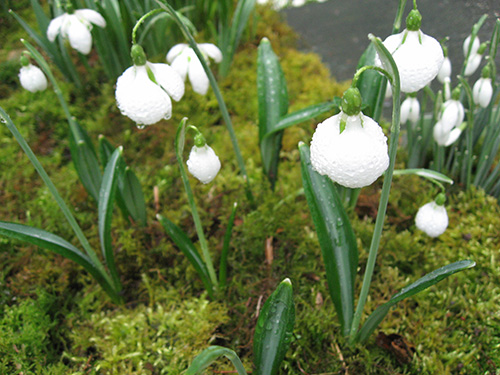
Whilst talking to snowdrop expert Jo Hynes, who gardens at Higher Cherubeer in Devon, a throwaway remark made me think. Jo told me that pulmonarias don’t mix well with her snowdrops and that set me thinking, because the one trait common among galanthophiles is the gaps that appear every year. We all lose prized plants and wonder why. Sometimes snowdrops just have a year off. More often than not though, they have gone for good. Kaput! All that’s left is a tombstone label.
Pulmonarias may possibly out-compete snowdrops by denying them light and rain, because they have a habit of extending their leaves as summer progresses. The common primrose does the same thing and I have taken most of my primroses out of my main snowdrop areas, for that reason. Another Norfolk snowdrop pal, Brian Ellis, has found that hardy geraniums cause him problems, so he doesn’t grow them anymore.
There are two main insect pests, that devour snowdrop bulbs, and both do most damage in the sunnier areas of the garden. It’s noticeable at Spring Cottage, that it’s a garden of two halves with far more snowdrops thriving in the shadier half of the garden rather than the sunnier areas. Last year’s summer bake seems to have caused lots of losses in the brighter areas, because the bulbs weren’t replenished after flowering. These sunnier areas are less well-drained when it’s hot and small bulbs need good drainage.
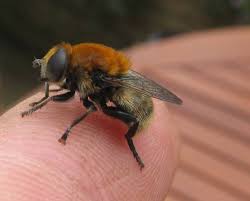
There might be another reason. The large narcissus bulb fly, Merodon equestris, loves to fly in sunshine. This hoverfly,a bumblebee mimic, makes a high-pitched drone as it flies. The females drop eggs close to snowdrop foliage. These eggs hatch out into tiny grubs and they wriggle down into the foliage. Then they get into the bulb and devour most of it as they fatten up. They do tend to stay in one bulb and they often leave part of the basal plate. Perhaps, it’s too much chewing. Sometimes the snowdrop grows back and flowers about three years later. This bumblebee look-alike is on the wing from the beginning of April up until May. Experts say that they’re feeding on microbes found in rotting bulbs, and not on healthy bulb tissue, although I’m not so sure.
The munch narcissus bulbs as well. The Cornish daffodil breeder Alec Gray (1895-1986), who bred 110 varieties including most of our miniature narcissi, describes killing 300 flies in a few hours using a home-made, foot-wide wire swat. My friend uses a badminton racket. They’re active in the middle of the day, preferring sunny places, so they rarely attack bulbs in shady positions. Gray observed in his 1955 book, Miniature Bulbs, that ‘a single heavy cloud across the sun will send them to shelter.’ There’s a lesser narcissus fly which lays several eggs near each bulb, but it’s the greater narcissus fly causes the most destruction.
The worst devourer is swift moth and these feed on plant roots of herbaceous perennials before moving on to your bulbs. There are two. The common swift moth, Hepialus lupulinus, and the ghost swift moth, H. humuli. Both produce brown-headed cream-white caterpillars. The RHS tell us that that these caterpillars ‘have three pairs of legs at the head end and five pairs of clasping prolegs on their abdomen.’ The problem is, they hunt in packs and they spend two years munching away before they pupate. They are partial to Michaelmas daisies, paeonies, chrysanthemums and strawberry plants – all of which I grow and will to continue to grow.
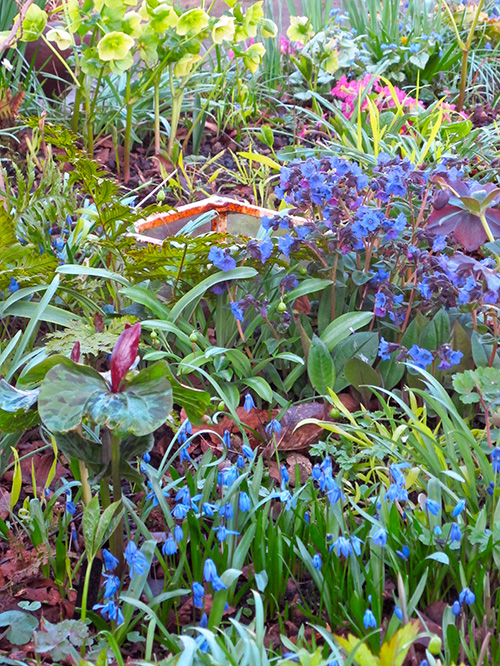
It’s not always about pests or aggressive plants. Certain plants exude toxins that stunt the growth of other plants and this is called allelopathy. I first noticed this effect over twenty years ago when growing a row of sweet peas. An aquilegia seedling popped up in my row and the two sweet peas on either side refused to grow whilst the others romped away. I imagined at the time that the tap-rooted aquilegia was robbing all the moisture and nutrients from the ground. Not do, for a couple of years later the same thing happened in a row of carrots, so I removed the aquilegia seedlings immediately. Despite that the carrots closest to where the aquilegia had been, refused to grow.
After much thought I concluded that the aquilegia had probably poisoned the soil. After all, these innocent looking flowers are members of our most toxic family, the buttercup or Ranunculacea. One member, Monkshood or aconitum, is particularly deadly and in recent years roots were added to one husband’s curry, with deadly results.
Some plants are able to stop others growing by exuding a chemical either above or below the ground. The most famous masters of allelopathy are the Black walnut or Juglans nigra. This tree produces a non-toxic, colourless chemical called hydrojuglone in its leaves, stems, fruit hulls, inner bark and roots. When exposed to the air, or to soil compounds, this oxidises into a highly toxic chemical called juglone. This retards growth, or kills outright, and stops almost all the competition thereby benefitting the tree. Our English walnut, Juglans regia, also produces the same chemical. One borders the garden. Oh joy!
In some trees the harmful chemical is contained in the leaves only, as in Prunus serotina (the Wild black cherry), or it’s in the leaves and bark as in Robinia pseudoacacia. It’s likely that tree seedlings exude this chemical in surprising amounts in order to get going. So next time you look at large tree with a patch of bare ground underneath you’ll know why. It’s chemical warfare. Many trees practice allelopathy to some degree and they include horse chestnut, some species of lime, poplar, pine and beech. It’s a good idea at remove any tree seedlings as soon as you spot them.
Other plants are regarded as good companions, although this concept is very misunderstood. I used to think that planting pungent African marigolds, sages, chives near vegetable crops would deter pests such as root flies and whiteflies. Many, including me, had great faith in this companion planting theory. RHS Wisley even did an experiment with tomatoes and single-flowered French marigolds (Tagetes patula) in one of their greenhouses. However, they found that the pungent foliage of the marigolds suffered from whitefly just as much as the tomato crop did.
The problem is, insects are not equipped with noses, so they don’t know whether a plant is pungent or not.
How do they do it then? Well, they use chemical receptors on their feet and mouthparts. Research carried out the HRI International, based at Wellesbourne in Warwickshire, by Stan Finch and Rosemary Collier in 2000 studied the behaviour of pest insects on brassicas. They observed that these insects landed on green surfaces, but avoided brown.
Then they surrounded the plants with green paper, so that the entire area was completely green. They discovered that these insects landed on the green paper and the foliage. They concluded that ‘insects do not appear to discriminate between green surfaces on the basis of differences in colour or odour.’ Finch and Collier also found that insects revisited plants and landed four consecutive times before laying their eggs on host plants.
If you have a mixture of leaf shapes all together, rather than one crop in a row, it will make it harder for pests to target crops. Rows are a relatively recent innovation having arrived after the invention of Jethro Tull’s seed drill in 1720. The old market gardeners, who supplied London with food in 17th centuries, scattered a mixture of three different crops and the proportions of these mixtures were closely guarded secrets. That would have confused the pests.
I have bought more snowdrops, of course, and any attempt to limit my purchases has failed. I have taken a certain amount of cash and promised myself that that is it! However, I go on to use a card. I also took cash for two plant sales and spent the whole lot at the first one!
I just hope that some survive the vagaries of the weather, the toxic poisoners I may have and the jaws of caterpillars and fly larvae that I probably do have!