




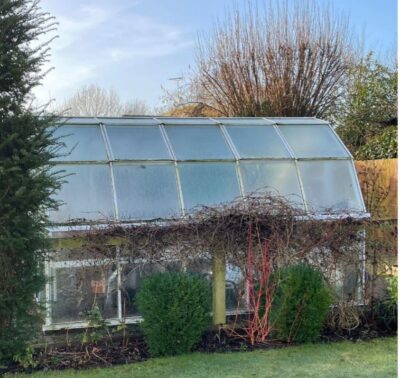
My greenhouse wasn’t cleaned last year due to my ongoing ill health but my wife, Gill and great friend, Father Hugh Flower a Kew trained, motor cycle riding Catholic priest have penciled in a date to do this for me. Follow the more detailed instructions in September 2025 and previous diaries but choose a sunny day, put your plants in a sheltered, sunny spot outside and cover them with horticultural fleece or divide your greenhouse into two, cleaning one half and then the other, so you don’t have to put plants outside.
It’s still not too late to sow sweet peas in a frost free, sunny greenhouse and pinch out the tips of autumn sown plants to encourage side shoots to form.
Towards the end of the month, soak dahlia tubers in a bucket of tepid water for an hour, then plant in trays of peat free compost, to encourage new shoots to form for cuttings and earlier flowering. Make sure that your greenhouse remains frost free; February can end with a bite.
Remove the flower heads of Hippeastrums, but not the stems and feed once a week with liquid general fertilizer to bulk up the bulbs for next year’s flowering.
Continue to check your greenhouse for pests and diseases, treating them with environmentally friendly controls to reduce numbers before the growing season starts and the weather warms up.
If your greenhouse has borders, incorporate a layer of well-rotted organic matter into the top few inches of soil using a garden fork. Water the surface and remove germinating weed seedlings as they appear, well before they flower and set seed. The seedings make an excellent activator for compost heaps but hopefully there will not be too many to add.
This month’s big event is sowing plants like bell peppers, chillies and aubergines. This year I am sowing – among others – Czech Aubergines and American courgettes. They all need up to five months to mature and gardeners who complain that their peppers haven’t ripened, have usually sown their seed too late, though weather can be a factor, of course. The third week in February is ideal, mid-March is fine and the first week in April is the limit. They need warm, light conditions and constant temperatures, so if you are unable to provide these, buy ‘plugs’ or young plants from the garden centre or internet. (This also saves space in the greenhouse).
Water the surface of a 10cm pot of seed or multipurpose compost with a fine rose, using tepid water and leave it to drain for at least half an hour. Sow the seeds over the surface, six to a pot, then cover with a shallow layer of fine grade vermiculite. Put the pot in a propagator at 18-21C (64 -70F); they take about three weeks to germinate.
Transplant when they are large enough to handle, lifting the seedlings gently by a leaf, into a 9cm pot and grow them on in the greenhouse at 10-15C. Make sure that there is enough space between the pots so the seedlings don’t become elongated in search of the light. Once the pots are full of roots but not ‘pot bound’ they can be moved into their final growing position in a heated greenhouse in 25cm pots of growing bag compost or growing bags. If the greenhouse is unheated, sow later when the weather is warmer and don’t plant them out until May. Modules are an even better alternative as there is less root disturbance, it depends how ‘old school’ you are. Happy gardening, Matt.