


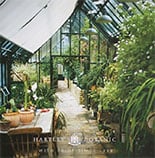


I am the proud owner of two Hartley greenhouses, one heated and one unheated. I have a problem, Houston! They’re just not big enough at this time of year for all the things I want to grow. By early May they’re both groaning under the weight of dahlias, tomatoes, pelargoniums, countless annuals, sweetcorn, peppers and aubergines. If I didn’t have my greenhouses I’d have to buy in, at vast expense, and I’d struggle to find the varieties I aspire to grow.
My greenhouses allow me to conjure up my own brand of magic because the glass creates a warm light environment. You can almost hear things growing – whatever the weather’s doing outside. Many of my plants have to stay under glass until the first week of June here because they’re frost tender. Frost would damage them, or check their growth. In the meantime, the plants in the unheated greenhouse have to be fleeced or bubble-wrapped on cool nights to keep them snug. Bubble wrap is the gardeners’ friend at this time of year, because it’s light enough to cover your dahlias etc without squashing them flat. Fleece, which isn’t as warm, can get soggy. This year’s May has been a real challenge. Cold nights, cool days and sometimes biting easterlies have been on the menu. My plants in the unheated greenhouse have shrugged it all off.

There are so many things I couldn’t do unless I had greenhouses and I get to immerse myself in a warm bubble on colder days. And we get plenty of those in Cold Aston. I have to confess though. I DO suffer from ‘greenhouse envy’ every time I walk up the village to the allotment. You see, there’s a much large Hartley further up the road and my heart sinks every time I catch sight of. I try to look the other way. Still. I’m able to grow at least a dozen different tomatoes from seed, with the aid of two rather ancient Vitopod propagators in the heated greenhouse.
I began growing my own tomato plants years ago, when I realised that I could only get about 3 varieties from garden centres. One was ‘Moneymaker’, and the large red fruits are tasteless and squashy. ‘Shirley’ was another and that has been replaced by the better ‘Akron’, a superb F1 variety. F1 seed is expensive but it’s more vigorous at every stage. And that includes germination. Raising one plant may cost you 50p – 70p, but heaven knows how much tomato plants cost at garden centres these days.

The real problem with buying ready-grown tomato plants is they have often developed blackened foliage due to being cold shocked because they’ve been put outside too early. These tender South American plants won’t go on to crop well, unless they’re kept warm. My seeds get sown in March into round 9cm pots that have already been washed. I use seed sowing compost and fill the pots to within a half to a quarter of an inch below the rim. Water the pots before you sow, using tap water that has been allowed to stand in a can, and allow your pots to drain. Add your label and scatter the seeds VERY thinly over the compost. Lightly cover the seeds with a smattering of compost. Place in the propagator. Keep the lid on overnight, but remove it on fine days to discourage fungal disease.
The seeds normally take a week or ten days to germinate, so your pots should not need watering until the first seedlings appear. Plunge your finger right in and, if the compost feels damp, leave well alone. Small seedlings and plants should not sit in damp compost, because it doesn’t encourage good root systems. Drier is better. Once your tomato seedlings develop 2 – 4 true leaves gently prick them out into individual 9cm pots. Handle them by the lowest seed leaves – also known as the cotyledons. Transfer to slightly larger pots and, when they get taller, go on to larger pots and add supportive canes with cane toppers or small upended pots.

My tomatoes go from the warmth of the heated green house into the unheated one in mid-May but only if the weather’s warmed up. Outdoor pots need to wait until the end of May, or the first week of June. I grow all my tomatoes in large pots, to limit diseases from the soil, and I prefer cordon varieties with a straight main stem. You have to remove the side shoots that spring up between the stem and the main leaves. Watering in the morning seems to promote better growth and to be careful and avoid splashing the foliage. Once the first truss of flowers appears, feed them with liquid tomato food every 10 days, following the instructions. Allow each plant to develop 6 – 7 trusses.
My favourite varieties are all delicious to eat and I like a mixture of colours on the plate. There are two modern American-bred Burpees varieties bred to resist blight. ‘Black Moon’ F1 has small oval the black fruits that develop some red skin when rip. It crops later than many. Bliss F1 bears a heavy crop of yellow fruits, lightly striped in green, with a tangy taste. There are two blight resistant UK varieties. ‘Crimson Crush’ F1 has medfium-sized round red fruits and there’s now a smaller fruited one called ‘Cocktail Crush’.
Cherry tomatoes are highly popular and last year I did well with ‘Toddler’ F1. The smaller extremely sweet red tomatoes on long trusses of up to sixteen. It’s very disease resistant, but I’ve found it slower to germinate from seed. Sweet Million F1 is also excellent because the long trusses bear sweet, round, bright red fruits in profusion. This one’s sold in supermarkets. ‘Sungold’, an orange cherry tomato, is another I grow although I think it’s lost vigour over the years.

If you want to grow a really heavy cropper, opt for ‘Britain’s Breakfast’. The lemon-shaped red tomatoes are formed on wide ballerina trusses containing up to 60 fruits. I wouldn’t be without this one and the tomatoes don’t split. It fruits for ages and it fries and cooks really well. The best round orange one for me is ‘Orange Wellington’ F1, an orange beefsteak that crops heavily and you can eat it raw, or cook it. It’s almost seedless. ‘Golden Sunrise’ produces medium-sized warm-yellow fruits with a wonderful flavour and it crops early on. This year I’ve added another beefsteak, ‘Buffalo Sun’ F1, a yellow with a reddish-brown flame. The beefsteaks get eaten fresh, but ‘him indoors’ makes passata and freezes it for winter use. Cooked tomatoes contain more lycopene, a carotenoid pigment that fights off free radicals.
I raise all my brassicas, Brussels sprouts, cabbages, kale and purple sprouting, broad beans, lettuces and sweet corn in the unheated green house and they get sown in 5 x 3 modular trays with 15 spaces. The secret to growing cabbages well is to plant them out once the roots reach the bottom of the plug. If you let them stall, the leaves go pink and they suffer. Early May is a good time to get them in, because they’re hardy, but you will need to net them against bird attack and cabbage white butterflies. Give them some nitrogen using chicken pellets, or powdered 6X

Easy to handle annual seeds are also sown in March, into modular trays with 28 spaces. Cosmos, cornflower, pot marigold, French marigold and bupleurum get a pinch in each plug and they can go into the borders in early May because they’re hardy. Frost-tender nasturtiums get the same treatment, but are sown in April and don’t go outside until early June.
My galvanised containers of pelargoniums and plectranthus, using plants raised from cuttings that have spent the winter in the heated greenhouse, plump up in the unheated greenhouse. They are due to decorate the main door, but only go outside once we sense summer is here. This year it’s likely to be late May. The dahlias are also ladies in waiting and one of them ‘Admiral Rawlings’ is already four feet high and already in bud. A hundred or more will be planted on the allotment at the end of May – if we think summer’s here.
Once the dahlias have gone the tomatoes, cucumbers, peppers and aubergines will fill the unheated greenhouse and I can look forward to cucumber sandwiches for afternoon teatime. The best thing of all though, is the smell of a greenhouse full of plants. It’s like summer rain on parched ground, known as petrichor, but tripled. The sweet smell of success can’t be beaten.