



Solar technology is developing apace – but that’s not without controversy. For friction-free, life-enriching solar power, think no-tech – and look no further than your garden.
I’m in my greenhouse, cheeks warmed by spring sunshine: calm, relaxed – smug, even.
Beyond the glass, the sun at large is sending society into a bad-tempered frenzy; argy-bargy over the siting of solar panels on farmland has been raging for months. The granting of licences for new, large-scale solar farms (solar voltaic panels mounted on the ground, rather than on the roofs of buildings) has got folk worked up into a right solar spin. Misinformation about the negative effects of placing solar panels on land is rife. Falsehoods abound – all entangled with genuine, legitimate concerns.

Wars and their knock-on effects on the flow and price of fossil fuels – oil and gas – are helping to refocus attention on clean, green and renewable energy sources, thrusting wind and solar power back into the spotlight. Unlike fossil fuels, no one can blockade the sun and the wind, throttle their flow – or hold them hostage.
I was basking in my greenhouse when I caught the recent news that we’ll soon be able to buy small, domestic solar panels that simply plug into a normal three-pin socket, with no need for an electrician to visit, and at a fraction of the cost of roof-mounted systems. Already widely used in Europe – nicknamed ‘balcony power stations’ – these will generate electricity during daytime that appliances will use first before drawing on the national power grid, easing pressure on it.
In effect, this electricity will be free (the payback period on the panels will vary depending on usage) – democratised solar, we might call it. A few months from now I might be typing my words for ‘Renewable Gardening’ powered directly by free, non-polluting and renewable modern sunshine.
Cheeks now sizzling in the sunshine, I’m off to a shadier spot in my greenhouse, unable to resist another surge of smugness.

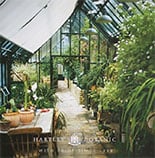
Looking around at the pots and trays of germinating seeds, it struck me how I’ve never been in a tizzy or had a spat with anyone about the benefits of solar energy. Most of my life has been spent using it to sow, propagate and grow the plants that have enriched, inspired and powered my writing for decades. They’ve fed me, too, and brought beauty and wonder into my world. That sunshine was harvested quietly, year-round, without any fuss, using the simplest of timeless and fuss-free technologies: a greenhouse.
When the sun shines on your greenhouse, it raises your gardening game, opens up endless possibilities, turns you into a season-stretcher, and supercharges your scope for giving more than you take from our struggling living world. We gardeners are the original pioneers when it comes to harnessing solar energy – so it’s OK for you to feel smug too.
It’s getting hot now, even in the shade.

One controversy poking the solar hornets’ nest is the effect solar farms might have on our natural world. A common claim doing the misinformation rounds is that they’ll damage or poison the soil, and the life in it, and will have a detrimental effect on wild life in general (the idea that waterfowl will crash-land on fields of solar panels, mistaking them for water, is yet to be proven…). A recent scientific study actually found that solar farms can lead to an increase in biodiversity; they create micro-habitats and niches where more species of birds and insects can live.
Agrivoltaics or agri-PV solar farms go further, integrating the generation of electricity with the growing of food crops, or the rearing of livestock, often sheep, meaning that the land provides multiple outputs.

Greenhouse gardeners are in the multiple outputs game, too. Only sunshine is used to raise all my plants; I don’t heat my greenhouse – my propagator is my living room – and I duck and dive with our ever more elastic seasons. My lean-to, despite facing northeast, is the garden’s engine room. Here I grow flowers chosen for their insect-boosting credentials, which get planted out in the garden, as well as year-round food crops. I also start off an increasing number of native trees (my bit in helping to restore the Welsh rainforest), and so much more. It’s a sun-warmed, tea-drinking sanctuary, too.
It’s a scorcher, and the vents are now fully open.
When I give plants to family and friends, or donate them to local plant sales, or plant treelings where sheep can’t eat them, the output of my greenhouse reaches way beyond my garden’s boundary. All of it is made possible by a modest patch of earth carrying a structure employing the most straightforward of solar harvesting techniques: sunshine passing through glass (your glazing material may vary).
There are no cables or wires, no micro-inverters, no fixings, no switches, no plugs, no sockets, no complicated gubbins at all: just a frame, doors and vents. I don’t need to plug it in – I just need to keep the glass clean. When the sun comes up, it’s powered up. It never breaks down or needs servicing. It didn’t court controversy when it went up, no one protested against it, and it has never been the source of any quarrelsomeness since – bar the spring I had to read the riot act to the grey squirrels, their mouths drooling strawberry red.
None of the sunshine that’s powered my greenhouse has cost me a penny – it never will – and I haven’t calculated the financial payback since I bought it (it was an investment in happiness). But it’s still paying me back, two decades later, each and every day, with immeasurable, life-enriching joy. Quietly and calmly, without vexing anyone.
Phew. It’s time to go outside.
Words and images © John Walker
Find John on X @earthFgardener